Magazine Posts

Russia's disinformation campaign hides the truth and offers false news narratives as it closes access to independent news sources and shuts down public demonstrations and opposition to the war... Read more

In 1997 California use to provide 90% of the avocados consumed in the US. Today, as the result of changes implemented as part of NAFTA, Mexico provides 80% of a much larger avocado consumption in the U.S. The avocado trade high prices and high profit margins have attracted the interest of the Mexicans crime cartels. A major disruption of this market could have a major negative effect on the American consumer as briefly shown during the U.S. Department of Agriculture ban of avocado imports from Mexico on February this year Read more

Cambridge University scientists James D. Watson and Francis Crick announced on February 28.1953 that they had determined the double-helix structure of DNA (short for deoxyribonucleic acid). DNA was discovered in 1869 but its significant genetic inheritance role was not demonstrated until 1943. Many other Scientists were working on figuring out the structure of DNA. Read more

A $6 million project at Leque Island is already seeing “overwhelmingly positive” signs of a healthier ecosystem ... Read more

A Comment by Loy

Your avatar
Loy • 02/28/2022 at 07:28PM • Like • Profile

So happy to watch this and learn of the positive results! - hope the fish and wildlife continue to thrive in the estuary.

A congressional effort to fix the nation’s deteriorating mail service may come at the expense of an even bigger and more complicated problem: Medicare solvency.

The Postal Service Reform Act of 2022 would help shore up post office finances by ending the unusual and onerous legal requirement to fund 75 years of retirement health benefits in advance. In return, it would require future Postal Service retirees to enroll in Medicare.

According to the Congressional Budget Office, the move could save the postal retirement and health programs about $5.6 billion through 2031 while adding $5.5 billion in costs to Medicare during that span, and probably much more in later years.

Considering the massive size of Medicare — it spent $926 billion in 2020 — the costs don’t amount to much. That small financial impact, and the ongoing immediate crises with mail delivery, probably account for the strong bipartisan support the postal bill has received in Congress, with 120 Republicans joining Democrats to pass the bill in the House on Feb. 8.

But late in the process, some lawmakers are raising alarms over the move, arguing that maybe Congress should look more carefully at the financial impact to Medicare’s trust fund, which is expected to run dry in 2026.

“This bill simply shifts risk to Medicare recipients by adding billions of new costs to Medicare,” Sen. Rick Scott (R-Fla.) said Feb. 14 in blocking requests on the Senate floor to expedite passage of the bill. Scott’s objection delayed consideration of the bill until early March, after the Senate returns from its Presidents Day break.

Currently, Postal Service employees are covered by plans offered in the Federal Employees Health Benefits program. When they retire they have several choices for health care, including staying in their original plan or switching to Medicare as their primary coverage and having an FEHB plan serve as supplementary coverage. About 20% of postal retirees do not sign up for Medicare, preferring their current federal plan. Under this legislation, they would have to switch to Medicare, but they would keep a new Postal Service version of the FEHB plan as secondary coverage.

Since the change wouldn’t fully take effect until 2025, and the Congressional Budget Office’s cost estimate doesn’t capture a full decade, Scott wants to know the price tag for the next 10- and 20-year periods, as well as the specific impacts on the various components of Medicare, such as premiums for Medicare’s Part D drug plan and the Part B program, which covers a variety of outpatient services.

The overall cost is likely to be much more significant than the shorter-term analysis found, said Robert Moffit, a senior fellow at the conservative Heritage Foundation, who has also raised concerns.

“There is a total cost that’s being ignored,” Moffit said. “You basically have a situation where you have unfunded liabilities in the Postal Service Health Benefits Program, retiree benefits, that amount to about $75 billion.”

That projected cost doesn’t vanish. It falls on Medicare, though the exact impact is unclear. Moffit agreed with Scott that Congress should be looking at longer-term implications, including effects on premiums and the costs borne by taxpayers and beneficiaries.

“We ought to step back, take a deep breath, and look at what we’re doing here,” Moffit said.

Postal Service unions are not worried about the change, however, with all of them supporting the switch, noted Democrats who responded to Scott earlier this month.

Senate Majority Leader Chuck Schumer argued that the bill would save the government money overall, and that moving postal retirees into Medicare would ensure that they receive benefits they’ve paid for but were not using.

For Schumer and most other lawmakers, the comparatively small impact on Medicare is simply not as pressing as getting the mail delivered on time.

“We will pass this bill because America needs it. Rural people need it. Senior citizens need it. Veterans need it — 80% of the veterans’ prescriptions are sent through the mail,” Schumer said. “Nobody should be standing in the way of this bill.”

Scott is now among a minority objecting to the latest effort and pointing to Medicare.

Others who remain concerned about Medicare’s poor finances also thought fixing the problems with postal delivery was worth the cost to Medicare.

“I would let Congress have a small win here and, really, this is not just a small win,” said Mary Johnson, a Social Security and Medicare policy analyst at the Senior Citizens League advocacy group.

She said the failures of the mail system also have health consequences, with payments for insurance and shipments of prescriptions going missing, which has happened to her.

The shift to Medicare envisioned in the legislation could add to the sense of urgency — all those retired postal workers would be joining Medicare just in time for a solvency crisis if Congress drags its feet. “It’s inaction in Congress that would cause that,” Johnson said.

Johnson noted it will be difficult to reach a bipartisan consensus on something as momentous as Medicare reform. “You’re going to have to pass something, and it depends on who’s the majority. It may not be very pretty when it happens.”

John Herschel Glenn (1921 - 2016)) United States Marine Corps aviator, engineer, astronaut, businessman, and politician. He was the first American to orbit the Earth, circling it three times in 1962. third American in space and fifth person in history to be in space. He received the NASA Distinguished Service Medal in 1962, the Congressional Space Medal of Honor in 1978, was inducted into the U.S. Astronaut Hall of Fame in 1990, and received the Presidential Medal of Freedom in 2012..... Read more

A good read for those of us wondering how the U.S. Supply chain failed us and why available inventory is so sporadic. "Rampant outsourcing, financialization, monopolization, deregulation, and just-in-time logistics are the culprits". Read more

One-fifth. Nearly 20% of cancers worldwide are caused by a virus.
These viruses don’t cause cancer until long after they initially infect a person. Rather, the viruses teach the cells they take over how to escape the natural biological process of cell death. This strategy sets these altered cells on a path for other genetic changes that can cause full-blown cancer years down the road. Read more

"Mainstream news media outlets have, in recent years, begun to create advertisements that look like news articles on their websites and on social media....... These specific advertisements are called “native advertising,” but are also tagged as “sponsored content,” “partner post” or other labels consumers don’t understand. They look like news articles, with headlines, photos with captions and polished text. But really they are ads created by, or on behalf of, a paying advertiser... Read more

The U.S. Internal Revenue Service is planning to require citizens to create accounts with a private facial recognition company in order to file taxes online. The IRS is joining a growing number of federal and state agencies that have contracted with ID.me to authenticate the identities of people accessing services. 

Beginning this summer, you might need to upload a selfie and a photo ID to a private company, ID.me, if you want to file your taxes online.

The U.S. Internal Revenue Service is planning to require citizens to create accounts with a private facial recognition company in order to file taxes online. The IRS is joining a growing number of federal and state agencies that have contracted with ID.me to authenticate the identities of people accessing services.

The IRS’s move is aimed at cutting down on identity theft, a crime that affects millions of Americans. The IRS, in particular, has reported a number of tax filings from people claiming to be others, and fraud in many of the programs that were administered as part of the American Relief Plan has been a major concern to the government.

The IRS decision has prompted a backlash, in part over concerns about requiring citizens to use facial recognition technology and in part over difficulties some people have had in using the system, particularly with some state agencies that provide unemployment benefits. The reaction has prompted the IRS to revisit its decision.


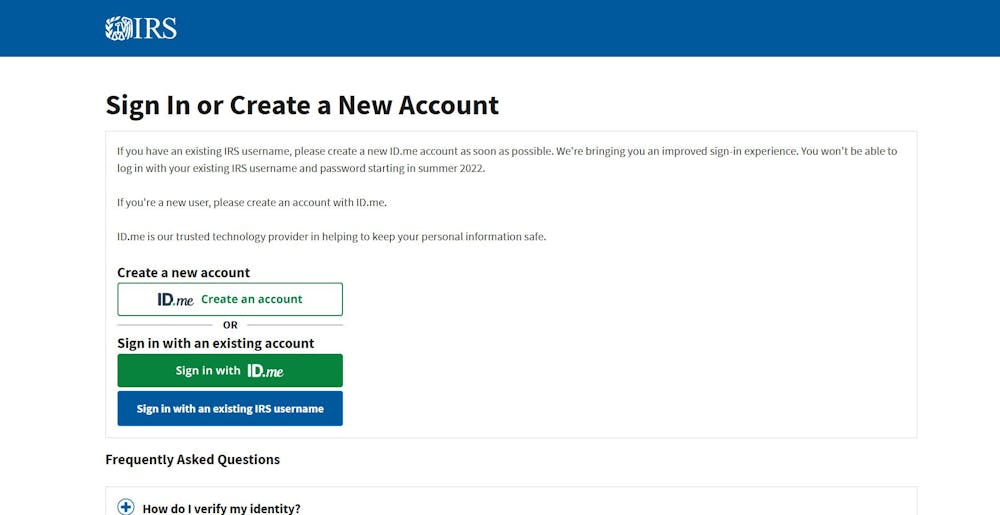
Here’s what greets you when you click the link to sign into your IRS account. If current plans remain in place, the blue button will go away in the summer of 2022.

As a computer science researcher and the chair of the Global Technology Policy Council of the Association for Computing Machinery, I have been involved in exploring some of the issues with government use of facial recognition technology, both its use and its potential flaws. There have been a great number of concerns raised over the general use of this technology in policing and other government functions, often focused on whether the accuracy of these algorithms can have discriminatory affects. In the case of ID.me, there are other issues involved as well.

ID dot who?

ID.me is a private company that formed as TroopSwap, a site that offered retail discounts to members of the armed forces. As part of that effort, the company created an ID service so that military staff who qualified for discounts at various companies could prove they were, indeed, service members. In 2013, the company renamed itself ID.me and started to market its ID service more broadly. The U.S. Department of Veterans Affairs began using the technology in 2016, the company’s first government use.

To use ID.me, a user loads a mobile phone app and takes a selfie – a photo of their own face. ID.me then compares that image to various IDs that it obtains either through open records or through information that applicants provide through the app. If it finds a match, it creates an account and uses image recognition for ID. If it cannot perform a match, users can contact a “trusted referee” and have a video call to fix the problem.

A number of companies and states have been using ID.me for several years. News reports have documented problems people have had with ID.me failing to authenticate them, and with the company’s customer support in resolving those problems. Also, the system’s technology requirements could widen the digital divide, making it harder for many of the people who need government services the most to access them.

But much of the concern about the IRS and other federal agencies using ID.me revolves around its use of facial recognition technology and collection of biometric data.

Accuracy and bias

To start with, there are a number of general concerns about the accuracy of facial recognition technologies and whether there are discriminatory biases in their accuracy. These have led the Association for Computing Machinery, among other organizations, to call for a moratorium on government use of facial recognition technology.

A study of commercial and academic facial recognition algorithms by the National Institute of Standards and Technology found that U.S. facial-matching algorithms generally have higher false positive rates for Asian and Black faces than for white faces, although recent results have improved. ID.me claims that there is no racial bias in its face-matching verification process.

There are many other conditions that can also cause inaccuracy – physical changes caused by illness or an accident, hair loss due to chemotherapy, color change due to aging, gender conversions and others. How any company, including ID.me, handles such situations is unclear, and this is one issue that has raised concerns. Imagine having a disfiguring accident and not being able to log into your medical insurance company’s website because of damage to your face.


Facial recognition technology is spreading fast. Is the technology – and society – ready?

Data privacy

There are other issues that go beyond the question of just how well the algorithm works. As part of its process, ID.me collects a very large amount of personal information. It has a very long and difficult-to-read privacy policy, but essentially while ID.me doesn’t share most of the personal information, it does share various information about internet use and website visits with other partners. The nature of these exchanges is not immediately apparent.

So one question that arises is what level of information the company shares with the government, and whether the information can be used in tracking U.S. citizens between regulated boundaries that apply to government agencies. Privacy advocates on both the left and right have long opposed any form of a mandatory uniform government identification card. Does handing off the identification to a private company allow the government to essentially achieve this through subterfuge? It’s not difficult to imagine that some states – and maybe eventually the federal government – could insist on an identification from ID.me or one of its competitors to access government services, get medical coverage and even to vote.

As Joy Buolamwini, an MIT AI researcher and founder of the Algorithmic Justice League, argued, beyond accuracy and bias issues is the question of the right not to use biometric technology. “Government pressure on citizens to share their biometric data with the government affects all of us — no matter your race, gender, or political affiliations,” she wrote.

Too many unknowns for comfort

Another issue is who audits ID.me for the security of its applications? While no one is accusing ID.me of bad practices, security researchers are worried about how the company may protect the incredible level of personal information it will end up with. Imagine a security breach that released the IRS information for millions of taxpayers. In the fast-changing world of cybersecurity, with threats ranging from individual hacking to international criminal activities, experts would like assurance that a company provided with so much personal information is using state-of-the-art security and keeping it up to date.

[Over 140,000 readers rely on The Conversation’s newsletters to understand the world. Sign up today.]

Much of the questioning of the IRS decision comes because these are early days for government use of private companies to provide biometric security, and some of the details are still not fully explained. Even if you grant that the IRS use of the technology is appropriately limited, this is potentially the start of what could quickly snowball to many government agencies using commercial facial recognition companies to get around regulations that were put in place specifically to rein in government powers.

The U.S. stands at the edge of a slippery slope, and while that doesn’t mean facial recognition technology shouldn’t be used at all, I believe it does mean that the government should put a lot more care and due diligence into exploring the terrain ahead before taking those critical first steps.

James Hendler, Professor of Computer, Web and Cognitive Sciences, Rensselaer Polytechnic Institute

This article is republished from The Conversation under a Creative Commons license. Read the original article.

Snohomish, Skagit and Island County

Read more from Pepe's Painting LLC

Hunger impacts all of us | 360-435-1631

Powered by Volunteers | 360-794-7959